🪨

Carved from the earth, carved for luxury

Cave Hotels

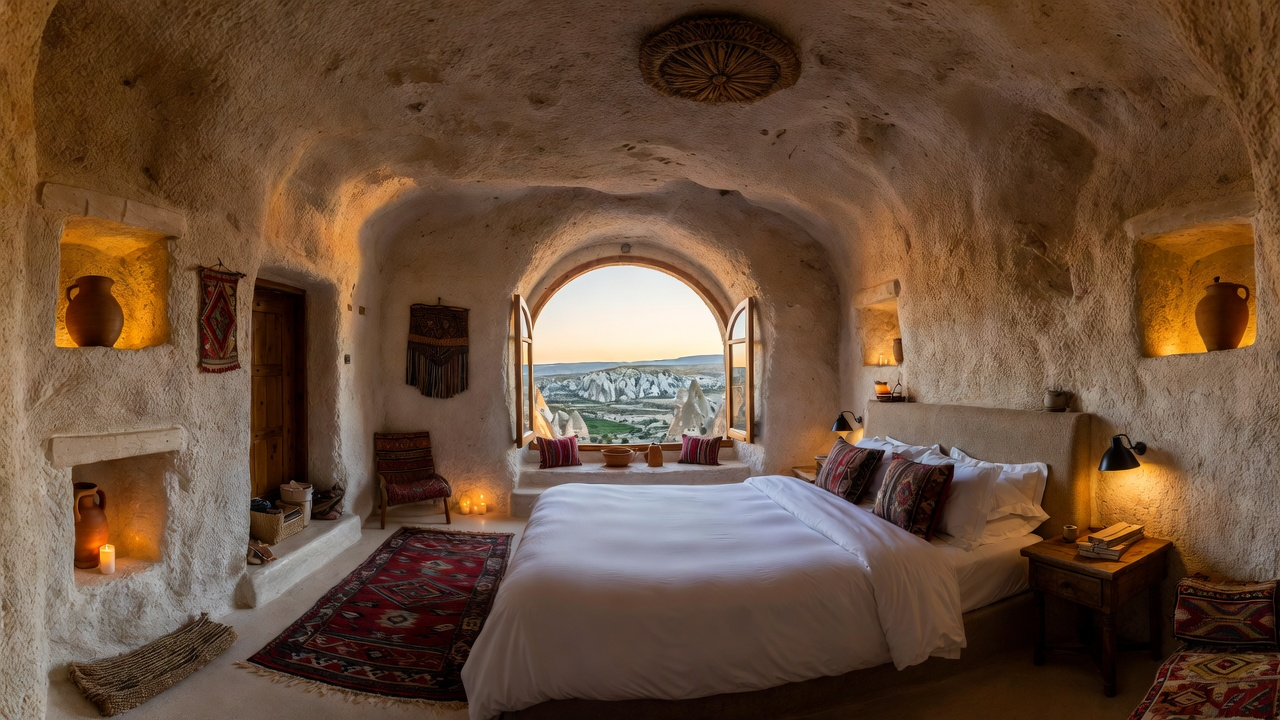
Carved from volcanic tufa, soft sandstone, and ancient limestone, cave hotels place you inside the earth itself. Turkey's legendary Cappadocia leads the world in cave hotel excellence, but extraordinary rock-hewn retreats also await in Greece, Spain, Tunisia, and the American Southwest.

View 7 Cave Hotels Stays

Category at a Glance

Total Stays 42
Avg. Price/Night $260
Top Destination Cappadocia, Turkey
← All Categories

Cave Hotels Stays

7 properties
Cappadocia Cave Suites
9.1
Cave Hotels Göreme, Cappadocia

Cappadocia Cave Suites

Carved into the volcanic tufa hillside at the centre of Göreme, Cappadocia Cave Suites occupies rooms that range from smoothed Byzantine cave spaces with barrel-vaulted ceilings to sharply cut suites finished with Anatolian tiles and kilim cushions. The rooftop terrace faces directly into the valley where 60 to 80 hot air balloons rise at dawn each morning — one of the more singular hotel views in Turkey.

Authentic cave suites carved into Göreme's volcanic tufa
Private terraces with panoramic balloon and fairy chimney views
From
$180
/ night
Cuevas Al Jatib
9.0
Cave Hotels Benalauría, Málaga, Andalusia

Cuevas Al Jatib

In the village of Benalauría, perched above 700 metres in the Genal Valley, Cuevas Al Jatib has restored a cluster of Moorish cave dwellings — cut directly into the limestone cliff — into cave suites whose rough rock arches and curved ceilings maintain 18°C year-round. The breakfast terrace looks out over chestnut forest dropping away to the blue shadow of the Sierra Bermeja, and Ronda is thirty kilometres down the valley road.

Authentic Moorish cave dwellings carved into white limestone cliffs
Natural rock walls and vaulted cave ceilings throughout
From
$120
/ night
Desert Cave Hotel
8.2
Cave Hotels Coober Pedy

Desert Cave Hotel

Carved into the opal-bearing sandstone of Coober Pedy — the town that produces 70% of the world's gem-quality opals and where most residents live underground to escape 50°C summers — the Desert Cave Hotel keeps a constant 23°C year-round, with gemstone seams visible in the corridor walls.

Rooms carved into opal-bearing sandstone, opals visible in the walls
Coober Pedy produces 70% of the world's opals
From
$150
/ night
Gamirasu Cave Hotel
9.1
Cave Hotels Ayvali, Cappadocia

Gamirasu Cave Hotel

Gamirasu occupies a genuine 6th-century Byzantine rock-cut monastery in the quieter Ayvali valley, thirty minutes from Göreme, where rooms still carry the carved niches and vaulted proportions of their original design. Balloon launches from the fields immediately below the hotel, a wine cellar stocked with volcanic-soil Cappadocian bottles, and a Turkish breakfast served on the terrace as the morning light moves across the fairy chimneys complete a stay that feels found rather than packaged.

Rooms in a genuine Byzantine-era rock-cut monastery (6th century AD)
Quieter Ayvali valley, far fewer visitors than Göreme or Üçhisar
From
$180
/ night
Museum Hotel
✦ Featured
9.6
Cave Hotels Uçhisar, Cappadocia

Museum Hotel

Positioned at the top of the Uçhisar rock formation — the highest point in Cappadocia — Museum Hotel fills 30 cave suites with a founder's private collection of Anatolian carpets, ceramics, textiles, and woodwork accumulated over decades, no two rooms alike. At dawn, balloon flights rise directly below terrace level, and Lil'a Restaurant serves elevated Anatolian cooking in a candlelit cave dining room that earns its own journey.

30 unique antique-furnished cave suites
Panoramic Cappadocian valley views
From
$400
/ night
Sextantio Le Grotte della Civita
9.3
Cave Hotels Matera, Basilicata

Sextantio Le Grotte della Civita

Cave rooms cut into Matera's Sasso Caveoso district, with rough tuff-stone walls and vaulted ceilings left as the 9,000-year-old rock formed them. Breakfast is served in a Rupestrian church where medieval frescoes still mark the walls.

Caves carved into Matera's 9,000-year-old sassi district
UNESCO World Heritage Site accommodation
From
$300
/ night
Sextantio Le Grotte della Civita
✦ Featured
9.4
Cave Hotels Matera

Sextantio Le Grotte della Civita

Eighteen cave chambers in Matera's ancient sassi district, restored to expose their original tuff-stone walls and vaulted ceilings rather than conceal them — a city once called 'the shame of Italy' now home to one of its most sought-after hotels.

Rooms carved into sassi caves inhabited since the Paleolithic era
UNESCO World Heritage Site, one of the oldest continuously inhabited settlements on earth
From
$300
/ night
About Cave Hotels

Cappadocia has been inhabited for over 2,000 years, with archaeological evidence of human presence in its cave systems stretching back considerably further. The region’s volcanic tufa — sculpted by erosion into the famous fairy chimneys and dramatic valleys — was ideally suited to cave dwelling: soft enough to carve with basic tools, yet hardening on exposure to air into durable, thermally stable living spaces. The cave hotels here aren’t novelties. They’re the latest iteration of an extremely long tradition.

Matera, in southern Italy, pushes the history deeper still. The Sassi di Matera, the ancient cave district carved into the ravines of Basilicata, has been continuously inhabited for approximately 9,000 years, making it one of the oldest human settlements on earth. After decades as a symbol of poverty — residents were forcibly relocated in the 1950s — the Sassi were inscribed as a UNESCO World Heritage Site and have since been converted into some of Italy’s most compelling boutique hotels, their ancient forms now housing designer furniture and locally sourced restaurant menus.

The defining characteristic of cave accommodation is its relationship with temperature. Rock maintains a consistent thermal mass year-round, with cave interiors typically hovering between 15°C and 18°C regardless of exterior conditions. In summer, this natural cooling is a genuine luxury: a cave suite stays comfortable without mechanical air conditioning when exterior temperatures in Cappadocia or southern Spain push past 35°C. In winter, the same thermal mass retains warmth efficiently, reducing heating requirements well below those of conventional construction.

That regulation is both practically useful and physically distinctive. The rock feels cool to the touch in summer, the air neither damp nor dry. It’s a relationship between structure and environment calibrated over geological time.

Authentic cave hotel rooms are cut directly into natural rock formations: walls, ceiling, and often the floor are living stone, shaped by geology and refined by human hands over centuries. Within these ancient shells, the better properties install heated floors, rainfall showers, fine linens, and selected art — creating an unlikely but effective dialogue between the ancient and the contemporary.

Light quality in cave rooms is its own thing entirely. Natural light enters through carved doorways and window embrasures, falling at angles determined by the original rock face rather than an architect’s plan. At certain times of day the results are genuinely beautiful. Some guests worry about claustrophobia before arrival, but a well-converted cave room is generally spacious rather than confining. The sheer thickness of the rock walls tends to produce a profound sense of shelter — most guests find it calming rather than oppressive.

Cappadocia, Turkey is the global capital of cave hotel accommodation, by some distance. The towns of Goreme, Uchisar, and Urgup contain cave hotels ranging from boutique guesthouses to five-star properties with rooftop infinity pools overlooking the otherworldly landscape. Sunrise hot air balloon flights above the fairy chimneys are among travel’s great spectacles — book them separately from your accommodation, as demand is intense and availability moves fast.

Santorini, Greece offers cliff-carved cave suites cut into the volcanic caldera rim, with terraces above one of the world’s most dramatic sea views. The cave aesthetic combines with whitewashed Cycladic architecture for a result that is, honestly, as good as the photographs suggest.

Matera, Italy offers a historical experience hard to beat anywhere: sleeping within the Sassi means inhabiting one of humanity’s oldest continuously occupied dwellings. Granada, Spain has cave houses (cuevas) in the hills above the Alhambra. New Mexico, USA has developed cave-adjacent adobe stays in the tradition of Ancestral Puebloan cliff dwellings. Australia’s Coober Pedy, an underground opal-mining town in the outback, offers cave motel rooms that are genuinely unlike anything else.

The best cave hotels in Cappadocia and Santorini book heavily during spring (April–May) and autumn (September–October), when temperatures are ideal and visitor numbers peak. For Cappadocia, book at least two months ahead. Cave hotels reward guests who slow down. The atmosphere encourages lingering over breakfast, sitting with a glass of local wine as the sun sets across ancient valleys.

For complementary geological drama at a different scale, cliffside hotels offer the outside-the-rock perspective that cave hotels provide from within.
Explore Other Categories