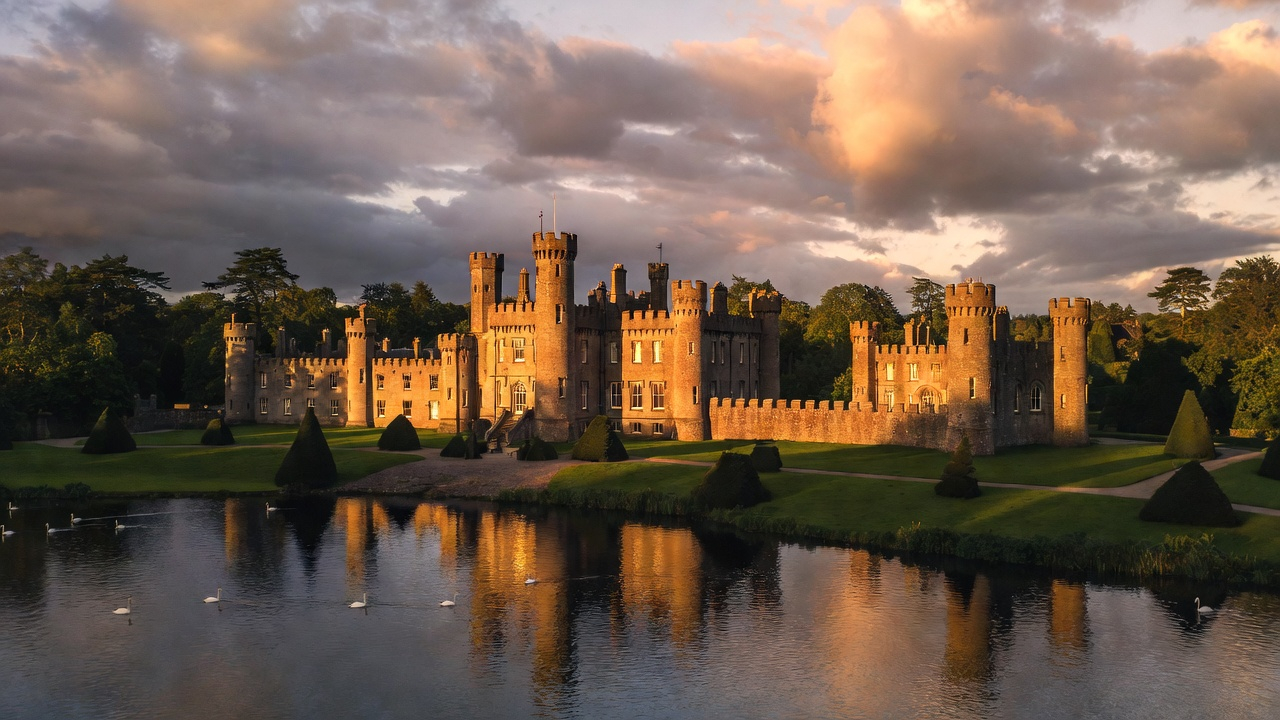
Pulling up the driveway of a genuine castle hotel, you’re arriving somewhere that has mattered to human history in ways no purpose built hotel ever could. The weight is in the stone underfoot, the thickness of the walls, the portraits lining the corridors, and the view across parkland that has looked much the same for five hundred years. A castle hotel isn’t simply a building with towers and battlements. It’s a structure that survived sieges, political upheavals, and centuries of slow erosion, and is still standing.
The category spans more than the single word suggests. True fortified castles, built specifically for military defence with battlements, towers, and in some cases working drawbridges and moats, represent the most dramatic end. Ireland’s Ashford Castle and Dromoland Castle fall here, their defensive origins still legible in their thick walls and elevated positions even after substantial Victorian-era expansion.
Castles with descendants still in residence are a particularly compelling subset. Some of Scotland’s finest castle hotels are still owned by the families who built them centuries ago, with current generations in private apartments while guests occupy the historic principal rooms. That continuity of ownership creates an authenticity that no amount of interior design investment can manufacture.
Stately homes and chateaux that blur the line between fortified castle and grand country house account for much of the category’s volume, particularly in France, where the Loire Valley’s Renaissance chateaux are elaborate palaces rather than military fortresses. Some purists draw that distinction sharply. For guests seeking historic accommodation of the first order, a great Loire Valley chateau delivers at least as much as any tower and drawbridge.
Restored ruins converted to hotels represent the most architecturally striking interpretation: roofless medieval walls enclosed within contemporary glass-and-steel insertions, ancient and modern in deliberate dialogue. Several Irish and Scottish properties push this approach to striking effect.
Castle hotels present hoteliers with genuine challenges that shape the guest experience. Thick stone walls insulate against sound effectively, but they also resist the retrofit of modern services. Underfloor heating in a 13th-century stone floor requires extraordinary craftsmanship. Plumbing through walls of medieval masonry demands specialist engineers. WiFi signal must navigate stone densities no router was designed to penetrate.
The best castle hotel operators have solved these problems invisibly. You lie in a four-poster bed in a room with stone window embrasures three feet deep, the heating is exactly right, the linen is immaculate, and nothing feels anachronistic.
Narrow spiral staircases, designed to allow a right-handed swordsman to descend while an attacker coming up found their sword arm against the central pillar, are a reality in many castle hotels. Room allocation for guests with mobility considerations is worth discussing at booking. The thick walls also mean rooms can feel cool even in summer; most properties compensate with in-room fireplaces and electric blankets.
The best castle hotel activities are shaped by place and history in ways no contemporary hotel can manufacture. Falconry is among the most popular, with flying Harris hawks and peregrines in the parkland around an Irish castle a morning activity of genuine spectacle. Medieval banquets at properties including Bunratty Castle in County Clare combine theatrical history with surprisingly good food. Whisky tastings at Scottish castle hotels, guided by resident experts and drawing from cellars that may contain bottles older than the current owner, are experiences available nowhere else.
Horse riding through estate forestry, fly fishing on private salmon rivers, archery on the castle lawn, and afternoon tea in a drawing room hung with ancestral portraits: that’s the texture of a great castle hotel stay.
Ireland leads the world in castle hotel hospitality. The country has the highest concentration of castle hotels of any nation. Dromoland in County Clare, Ashford in County Mayo, Ballynahinch in Connemara, and Kilkea in County Kildare represent the apex of the form, genuine historic architecture combined with the warmth of Irish hospitality.
Scotland offers the most dramatically situated properties: baronial towers on windswept Highland estates, island fortresses accessible only by boat, and Victorian shooting lodges where the line between castle and grand country house dissolves entirely. France’s Loire Valley is chateau heartland: Renaissance palaces in formal gardens now operating as boutique hotels of exceptional quality. Central Europe, including Czech Republic, Austria, and Germany’s Rhine Valley, offers castle hotels at a wider range of price points than the Irish or Scottish properties.
Ireland’s castle hotels book heavily for weddings and special occasions; three to six months advance booking is advisable for summer stays. Look for packages combining accommodation with experiences: falconry, estate fishing, and guided historical tours are often bundled. For guests seeking equally historic but architecturally contrasting accommodation, cave hotels offer ancient human-carved spaces at a very different scale.